A Book-to-Screen Watch: Track What the Narrator Cannot Carry
A book-to-screen watch reveals how voiceover, performance and image share a narrator’s work, helping you spot what adaptation changes and why.
The common mistake in a book-to-screen watch is to treat voiceover as the film’s substitute for the novel’s narrator. That misses the work done by faces, gestures, framing and sound, and can make an adaptation seem less expressive simply because it says less aloud. A better watch follows one question: what can the narrator state directly that the screen must divide among voice, performance and image?
A written narrator can name a feeling, explain a memory, qualify an observation or tell us what a character does not understand. A screen adaptation has no single equivalent. It can use spoken narration, but it can also make information visible, let an actor imply it, or leave it uncertain. The point of the exercise is not to rank these choices; it is to notice how each one changes what the audience knows and when.
Start with a passage that does more than describe events
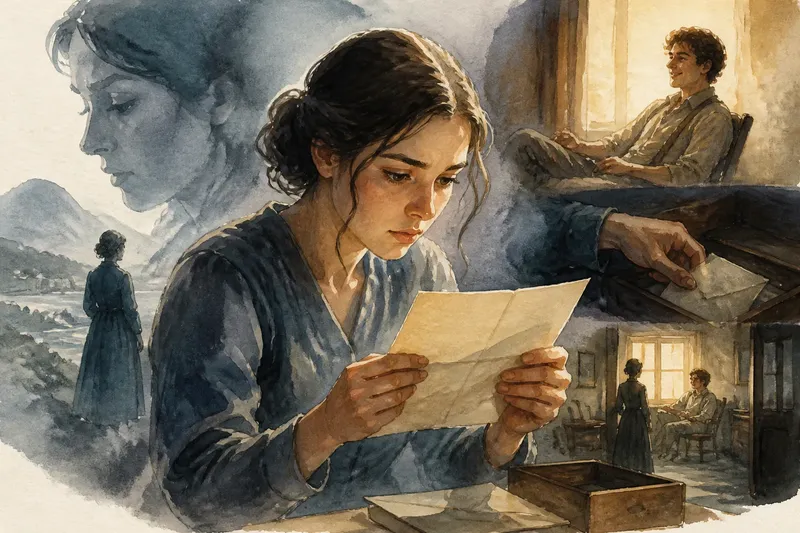
Choose a short passage in which the narration shapes our reading of what happens. A useful passage might combine an action with an interpretation: a character receives a letter, for instance, while the narrator hints that the character has misread its tone. A passage that merely lists visible movements may offer less to track.
Read the passage once for its literal events, then again for its point of view. Ask who is telling the story, how close that voice seems to the character, and whether it sounds certain, partial, amused or doubtful. Mark the details that would be hard to photograph directly: a judgement, a remembered sensation, a contradiction between belief and behaviour, or knowledge of another person’s private thoughts.
Keep the passage modest in scope. A single exchange or decision is easier to compare than a whole chapter, and it gives you room to notice small changes in emphasis. You do not need to expect the film to preserve every sentence; you are looking for the work each sentence performs.
Separate the narrator’s information into different jobs
Before watching, sort the passage’s information into a few practical categories. This prevents the comparison from becoming a vague judgement about whether a scene “feels faithful”.
- Event: what physically happens, such as a door being opened or a message being concealed.
- Interpretation: what the narration says the event means, or what a character thinks it means.
- Inner state: a feeling, intention or thought that cannot be seen directly.
- Context: background knowledge, memory or information about events outside the scene.
- Attitude: the narrator’s stance towards the character or event, which may be ironic, tender or sceptical.
These categories overlap, and a line can do several jobs at once. Still, separating them makes it easier to see whether an adaptation has omitted information, relocated it, or conveyed it by another means.
Say you choose an invented passage in which Mara reads a polite note, decides its writer is angry, and hides it from her brother. The passage states her suspicion and gives the narrator’s hint that she is probably wrong. In an invented screen version, Mara might reread the greeting, fold the note too carefully and look towards the brother before putting it away; the brother’s relaxed response may further unsettle her interpretation. The expected observable result is that viewers can infer her anxiety, while the narrator’s warning that she is mistaken may remain less certain.
Watch once for voiceover, then once for performance and image
On the first viewing, listen for spoken narration. Note whether it repeats the written passage, condenses it, adds a new perspective or contradicts what appears on screen. Voiceover can preserve a narrator’s distinctive language, but its presence does not automatically preserve the narrator’s authority: a confident voice over an image of confusion can create a gap between what is said and what is shown.
On a second viewing, lower your attention to the spoken words and track performance. Look for pauses, changes in eye contact, a held smile, a hand that stops before touching an object, or a response that arrives too quickly. Such choices can suggest a thought without naming it. They can also remain ambiguous: the same hesitation might signal fear, calculation or simple distraction.
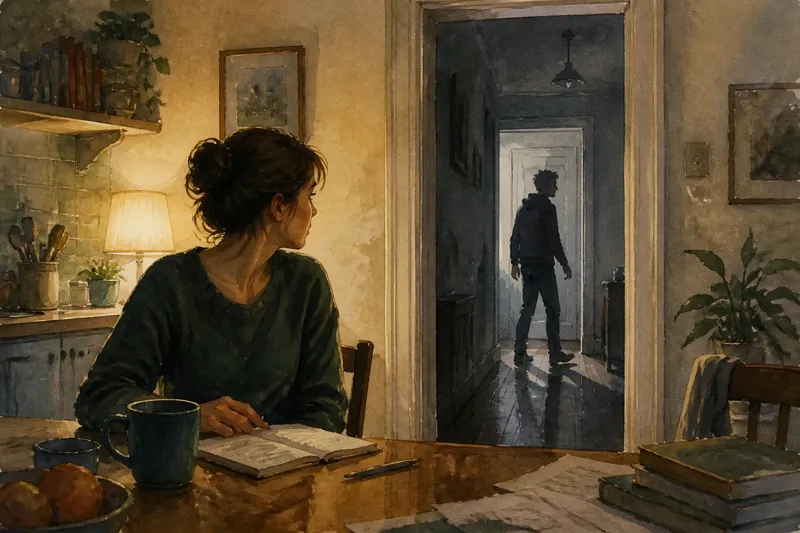
Then attend to the image. Notice what the camera makes easy to see and what it keeps outside the frame. A close view of the note may reveal a detail the character misses; a longer view of the room may let us notice another person watching. The image can supply evidence, but it does not always explain what that evidence means.
Sound beyond voiceover can shape the same inference. A chair scrape, a clock, or the sudden absence of ordinary room sound may draw attention to a pause, while dialogue from another room can provide context the character does not have. Treat these as part of the scene’s information, not as decoration around the “real” storytelling.
Ask what each screen element lets the audience know
For each important detail in the passage, identify the screen element that carries it. The answer may be voiceover, an actor’s behaviour, an object in the frame, dialogue, sound, editing, or no clear equivalent. More than one element may contribute, and some details may be intentionally dropped.
Next, compare certainty. A narrator can directly say that a character is jealous, even when the character denies it. A screen performance may make jealousy plausible without settling the matter. That change is not merely a change of medium; it alters the audience’s relationship to the character, because viewers must weigh visible clues rather than accept an explanation.
Also track timing. A novel can explain a motive before an action, afterwards, or in retrospect. A film can show the action first and allow a reaction to change its meaning later. If a viewer sees the concealed letter before hearing a character’s account of it, the scene creates one kind of expectation; if voiceover supplies the explanation first, it creates another.
Finally, distinguish a missing fact from a missing attitude. The adaptation may preserve the event and the character’s choice while dropping the narrator’s dry commentary. Nothing essential to the plot may be lost, yet the scene can feel warmer, harsher or more uncertain because the original voice’s judgement has disappeared.
What should you look for in a book-to-screen watch?
Does voiceover always represent the book’s narrator?
No. Voiceover may belong to a character speaking from a later point, a witness, or a perspective that differs from the novel’s narrator. Check what the voice knows and how its words relate to the images before treating it as a direct carry-over.
How can a film show a thought without explaining it?
It can pair behaviour with context: a glance at a particular object, a pause after a name, or a choice that conflicts with what a character says. These clues invite an inference, but their meaning may remain open rather than functioning as a literal translation of the written thought.
What if the screen version leaves a detail out?
Record the omission, then ask whether another element takes over the detail’s job. If nothing does, consider whether the scene has become less clear, more mysterious, or simply focused on a different concern; absence can be a deliberate change in emphasis.
Can performance and image contradict the narration?
Yes, and that friction can be the scene’s central effect. A character’s cheerful words might sit beside guarded behaviour, while a narrator insists that all is well; the viewer then has to decide which source deserves trust.
Turn your notes into a clear adaptation reading
After watching, write a short comparison that names the passage’s main narrative job and the screen choices that take it on. A useful note might say: “The book tells us she suspects the invitation is a trap; the film shows her checking the address twice, but does not confirm her suspicion.” That describes a change in information and certainty, rather than reducing the adaptation to a score for fidelity.
Include what the change does for the audience. Perhaps the book gives access to a character’s private logic, while the film makes that logic something viewers must infer. Or perhaps voiceover preserves an individual wit that the images alone would not communicate. One medium can make a point explicit; another can make it visible, audible or debatable.
Keep the distinction between evidence and interpretation clear. “She looks away when he mentions the letter” is an observable detail; “she is ashamed” is a reading of that detail. Naming both lets you explain how the adaptation invites a conclusion without pretending that every gesture has only one meaning.
A careful book-to-screen watch is most revealing when it tracks not just what survives, but who now carries the information. The narrator may give way to a voice, a face, a prop or a pause; sometimes the most meaningful adaptation choice is that nobody takes over, and the audience is left to notice the gap.