The Detective Always Notices: A Genre Promise, Not a Rule
Learn how to make detective-story clues feel meaningful without making every detail equally important, and plan their discovery across a story.
The common mistake in a detective story is to make every detail look like a clue; the cost is that viewers stop knowing where to look. A detective-story clue earns attention when it changes what a character can reasonably believe, not merely because the camera lingers on it. The genre promise is that the detective notices something meaningful. It is not a rule that every odd object, pause or glance must solve the case.
Writers can preserve that promise while varying how clues work. Some details should carry the investigation; others should deepen character, establish the setting or turn out to be ordinary. A week-long planning routine helps separate those functions before scenes are drafted, so the audience can follow the detective without feeling that every scrap of wallpaper is a secret message.
Begin the week by defining what the detective can know
On the first day, write down the case’s central question in a single sentence. Then note what the detective knows at the start, what remains uncertain, and what would count as a convincing answer. This is not a full plot outline. It is a boundary around the investigation, preventing a convenient clue from solving a question the story has not properly raised.
Next, choose the detective’s method of attention. One investigator may notice routines and timing; another may be alert to inconsistencies in speech, spatial arrangements or material traces. A method gives discoveries a recognisable source. If the character specialises in reading people, a sudden expertise in forensic chemistry needs a reason, a collaborator or a carefully established skill.
Finally, name the investigative pressure. Perhaps a witness is leaving town, the detective has limited access to a workplace, or a suspect’s account is about to become public. Pressure affects which clues can be pursued and what a missed opportunity costs. It also keeps the story from becoming a sequence of observations with no decisions attached.
On the second day, give clues different jobs
Divide possible details into three working groups. The labels are for the writer, not necessarily the audience, and a clue may change groups as the story develops.
- Case-bearing clues alter the likely explanation or help establish what happened. They should be traceable to a source and capable of being examined or challenged.
- Character clues tell us how someone thinks, hides, remembers or reacts. They may illuminate a motive without proving a crime.
- Texture details make a location and its people feel particular. They can catch the eye or create unease without carrying a hidden solution.
The distinction prevents a common confusion: a detail can be noticeable without being evidential. A peculiar mug on a desk may be there because its owner collects chipped ceramics. If the story later makes that mug decisive, it needs a clear connection to the case, not merely a close-up that trained the audience to suspect it.
For each case-bearing clue, write three notes: what is observed, what it suggests, and what else could explain it. “The office clock is several minutes slow” is an observation. “The appointment may have happened later than the witness says” is an inference. A power interruption or an unrepaired clock could offer another explanation. Separating these layers lets the detective reason rather than announce the answer.
Use the middle of the week to test the clue sequence
On the third day, put the case-bearing clues in the order the detective encounters them. For each one, record the change it produces: a new question, a revised suspicion, a reason to interview someone again, or a decision to check a record. If two clues produce the same change, consider combining them or giving one a different purpose.
Now look at the gaps between discoveries. The detective should sometimes act on incomplete information, and sometimes wait because a detail is ambiguous. A useful clue sequence does not simply accumulate facts; it shows a mind adjusting its working explanation. The audience can follow that adjustment even when it cannot yet name the culprit.
On the fourth day, check the order of presentation. If viewers see a clue before the detective does, ask what they are meant to do with that knowledge. They might anticipate a mistake, suspect a character or recognise a pattern only in hindsight. If they see it at the same time, the detective’s reaction can guide their attention. Neither arrangement is automatically fairer; each creates a different relationship between audience and investigator.
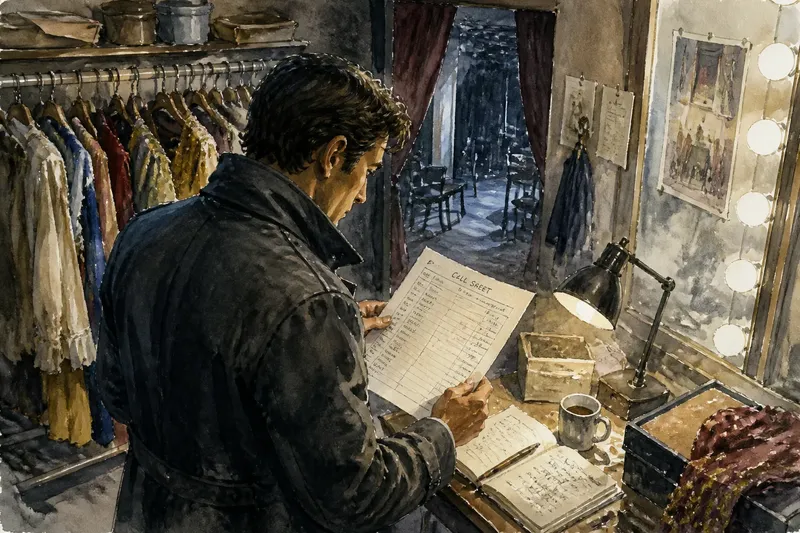
For instance, imagine a detective arriving at a small theatre after a dressing-room theft. The first visit establishes that several costume racks are crowded and that a stage manager keeps handwritten call sheets. Later, the detective notices that one performer’s name has been added in different ink. That alteration becomes meaningful because it affects who had access to the room; the crowded racks remain setting, not a second puzzle. The audience can understand why the call sheet matters without being asked to suspect every costume.
On the fifth day, challenge the promise with purpose
A writer can challenge the “detective always notices” expectation in several ways. The detective may overlook a detail because attention is finite, because a bias makes one explanation seem obvious, or because another urgent task takes priority. A witness might notice the decisive fact first. The detail might also be visible to everyone but meaningless until later information gives it context.
What matters is the consequence. If the detective misses something, the story should show what that costs: a mistaken accusation, lost access, a damaged relationship or a line of inquiry that has to be reopened. If another character notices it, give that character a credible reason to see it. These choices make attention part of the drama rather than a supernatural talent that switches on whenever the plot needs it.
Do not compensate for a missed clue by making every later detail equally loaded. Instead, let the detective recover through a changed question or a more careful method. A forgotten receipt may not solve the case by itself; it might prompt a check of a person’s timeline, which then reveals a contradiction. That chain gives the discovery weight without pretending one object contains the whole answer.
On the sixth day, check what the audience is being promised
Read the outline or draft with a simple question beside each conspicuous detail: does the story invite the audience to remember this? A lingering shot, a repeated line or a sudden pause can make an ordinary detail feel charged. Use those signals deliberately. If every object receives the same emphasis, viewers cannot distinguish a planted clue from visual texture.
Then examine the eventual explanation. A satisfying answer usually makes earlier evidence newly legible, while leaving room for details that were never part of the case. The solution should not require a hidden fact that had no fair route into the story. Nor does fairness demand that the audience solve the mystery first. It asks that the answer grows from material the story has actually made available.
One practical check is to describe the solution without using the detective’s interpretation. List the observable facts first, then explain how they support the conclusion. If the reasoning only works because the detective declares a detail significant, the clue may need a clearer connection or a competing explanation addressed on screen.
On the final day, revise for proportion
Use the last day of the routine to read the investigation as a viewer might experience it, not as a catalogue of hidden meanings. Mark the moments that change the case, the details that build character, and the details that simply make the world feel inhabited. If those categories blur, adjust emphasis or consequence rather than adding another clue.
For each important clue, ask whether it arrives at a useful point, whether the detective has a plausible way to interpret it, and whether the next action follows from that interpretation. Remove or soften clues that repeat an existing function. Keep an unimportant detail ordinary; that contrast protects the clues that truly redirect the story.
What makes a clue fair without making it obvious?
Does every clue need to be shown before the solution?
Every decisive piece of evidence needs a fair route into the story, but it does not always need a dramatic close-up. A detective can uncover an item through a credible interview or examination, provided the audience understands where it came from and why it matters.
Can a red herring be an ordinary detail?
Yes, if the misdirection comes from a reasonable inference rather than a false fact. A detail may support more than one explanation, but the story should not conceal information the detective already knows simply to prolong the mystery.
How can a detective miss a clue without seeming incompetent?
Give the oversight a specific cause, such as a mistaken assumption, competing pressure or limited access. Then let the missed detail produce a consequence and a believable route back to the investigation.
How many clues should lead to the answer?
There is no fixed count that suits every case. The useful question is whether the answer rests on enough independent support to feel reasoned, while each clue contributes something distinct rather than repeating the same revelation.
Let attention remain a choice, not a law
The detective-story promise is strongest when noticing has a cost, a method and a consequence. A detective may be observant without being omniscient, and a viewer may notice a detail that neither the character nor the plot treats as decisive. That freedom keeps the story’s world larger than its puzzle.
Use this week-long routine to shape the balance: define the question, assign clues different jobs, test their sequence, choose where attention falters, check the audience’s expectations, then revise for proportion. The result is not a trail in which every object matters equally, but an investigation in which the important details earn their importance through what the characters do with them.