The Doorway in the Frame: How a Threshold Directs Attention
Learn how a doorway directs attention in a film frame, using position, movement and focus to lead the eye without burdening the threshold with symbolism.
The most common mistake with a doorway in a film frame is treating it as a ready-made symbol: a character crosses it, so the moment must mean escape, danger or change. That assumption can distract from the more immediate work the doorway does, dividing the image, directing attention and shaping where a viewer expects movement to go.
To see how those choices operate, imagine a filmmaker composing an invented scene in a small flat. Mara is in the kitchen, listening as her brother Eli moves through the hall; the scene needs to show her attention shifting towards him before he appears. The doorway can make that shift legible without asking the audience to decode a hidden meaning.
A doorway divides the image into readable areas
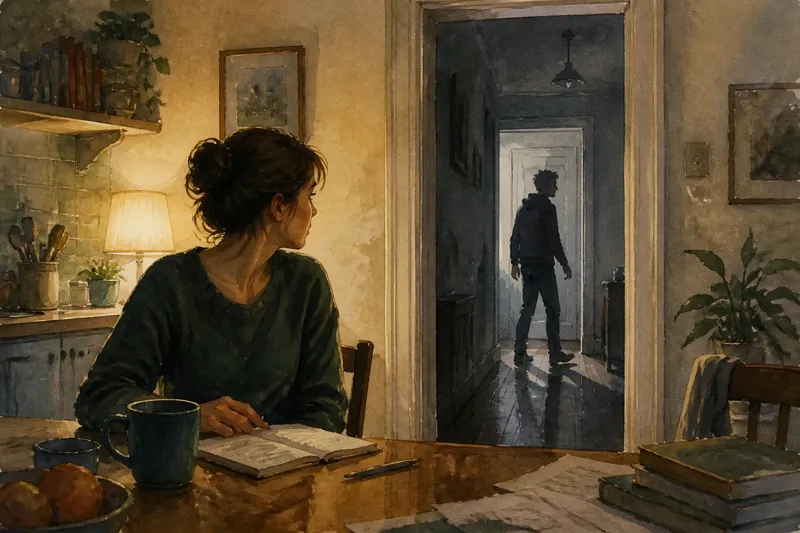
Suppose the first composition shows Mara at a kitchen table, with the open doorway near the right edge of the frame. Beyond it, the hall is darker and empty. The doorframe creates a clear boundary between two spaces, while the visible hall supplies a place for the viewer’s gaze to travel.
This division is practical rather than symbolic. The kitchen is where the scene’s visible action begins; the hall is where a possible interruption may arrive. The frame therefore gives the viewer two areas to monitor, but their different lighting and the doorway’s position make the kitchen the more prominent one at first.
A doorway can also make a crowded composition easier to read. Its vertical edges separate figures or objects that might otherwise overlap, and the lintel can mark a distinct upper boundary. If the architecture is visually busy, however, the frame may compete with faces and gestures; a director can keep the doorway at the edge or soften its prominence through focus and lighting.
Position and contrast set the first point of attention
In the imagined flat, Mara’s face is turned towards the table, and a lamp gives her the brightest area in the shot. The doorway remains visible but does not yet demand equal attention. This establishes a starting point: the viewer notices Mara, then registers the open space behind her.
Attention is not controlled by doorway position alone. Contrast, colour, sharpness, movement and the direction of a character’s gaze all contribute. A bright hall can pull the eye away from a face, while a dark doorway behind a brightly lit figure may read mainly as a background shape.
For this scene, the filmmaker keeps the hall slightly dim and the doorway unobstructed. Mara’s chair and the table edge point loosely towards it, but no prop is placed in the opening to create a competing shape. These choices make the threshold easy to notice without making it the picture’s most striking feature.
Movement turns the threshold into a visual cue
Now imagine Eli’s shadow crossing the strip of hall visible through the doorway. Mara pauses and looks up. The viewer can follow the shadow, then her gaze, to the same part of the frame; the doorway has become a route for attention as well as a boundary between rooms.
The timing matters. If Eli enters before Mara reacts, the viewer may notice his movement first. If Mara’s look comes just before he is visible, the empty opening briefly becomes the focus. Neither choice needs a symbolic explanation: each simply arranges what the viewer sees first and what is anticipated next.
A character can also move towards a doorway without crossing it. A step into the hall, a turn of the shoulders or a hand resting on the frame can all make the threshold visually active. The director can hold the shot, cut closer or move the camera with the actor; each choice changes how long the viewer has to study the space.
Focus decides which side of the doorway feels immediate
In the invented scene, the filmmaker begins with Mara sharp and the hall a little soft. When Eli appears, the focus shifts towards him. This change tells the eye where to settle, while the frame itself remains in place. The doorway’s edges help identify the space, but the focus change makes the person beyond it newly prominent.
Focus can work differently. If both rooms remain clear, the viewer can compare reactions across the threshold. If the hall stays blurred, Eli may first register as movement or colour rather than as a fully legible figure. A shallow focus is not automatically more expressive; it is useful when the scene benefits from withholding detail or directing attention narrowly.
Camera position affects the apparent shape of the opening, too. Looking straight through a doorway can make it feel broad and orderly; an oblique angle can compress the hall and hide part of what lies beyond. A low or high viewpoint may emphasise different relationships between the characters and the architecture. The choice should support the action the viewer needs to follow.
How does a doorway direct attention?
Does the doorway need to sit in the centre of the frame?
No. A doorway near an edge can still guide the eye if a character looks or moves towards it. Placing it centrally can make the opening more prominent, so the surrounding action should justify that emphasis.
Should the space beyond the doorway be brighter?
Not necessarily. A brighter hall may attract attention before a character does, while a dim one can keep the focus on the room in front. Choose contrast according to what the viewer should notice at that moment.
Can a closed door serve the same purpose?
A closed door still divides the image and establishes a possible route, but it does not show activity beyond the threshold. A handle turning, a moving shadow or a character watching the door can provide a cue without revealing the adjoining space.
When does a doorway become distracting?
It can compete with the scene if its lines, light or movement draw attention away from the action without a clear purpose. Simplifying the background or changing the camera angle may let the viewer read the faces and gestures more easily.
The result depends on a sequence of small choices
Return to the imagined flat: Mara begins in focus, Eli’s shadow crosses the dim hall, she looks towards the opening, and the focus shifts as he appears. The viewer’s attention moves from her face to the doorway and then to Eli. The threshold has directed that movement by making the spaces distinct and giving the action a visible path.
That result does not require the doorway to stand for a larger idea. It works because the shot gives the viewer clear visual information in a deliberate order. If the filmmaker wanted the audience to remain with Mara, the shadow and focus shift could be omitted; if the audience should scan both rooms, both sides could remain sharp.
When planning a shot, ask what the doorway makes visible, what it conceals and which action should attract attention first. Then check whether the frame’s contrast, actor movement and focus all support that order. Used this way, a doorway in the frame is a precise compositional tool: it guides the eye while leaving meaning to emerge from the scene’s actual choices.